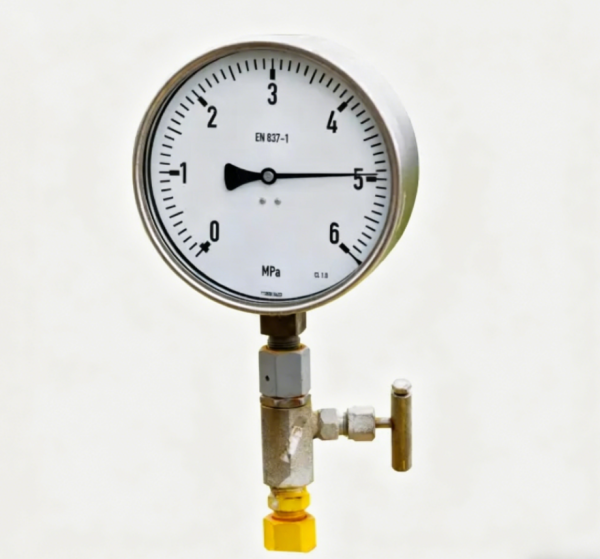
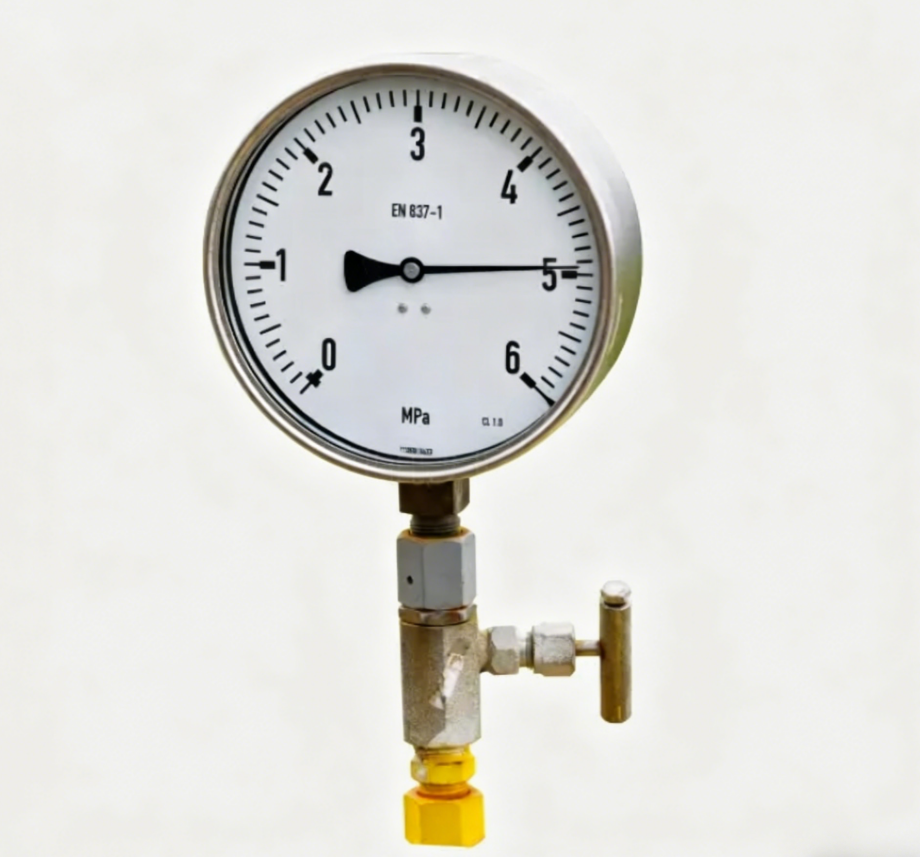
Wellhead pressure gauge
The wellhead pressure gauge is a critical monitoring instrument installed at the wellhead of oil and gas wells or water injection wells in the petroleum and natural gas extraction industry. It is used to measure the pressure of fluids (mixtures of oil, gas, and water or single-phase media) at the wellhead in real time, providing essential data support for production regulation, safety alerts, and well condition analysis.
Detailed description
Measurement range: 0~6 MPa (dial scale covers 0 to 6 MPa, pointer currently pointing to approximately 5 MPa position)
Accuracy level: 1.6 level (dial labeled “1.6”, representing measurement error ≤ ± 1.6% of full range, meeting the accuracy requirements of wellhead pressure monitoring)
Execution standard: EN 837-1 (European general standard for pressure gauges, ensuring that the structure and performance comply with international industrial specifications)
Interface form: Bottom threaded interface (yellow protective cap, speculated to be industrial threads such as NPT/BSP, suitable for wellhead pipelines); Side with needle valve for easy switching of medium during pressure testing or maintenance
Dial design: Circular dial with white background and black scale/pointer, clear scale (marked in sections of 0, 1, 2, 3, 4, 5, and 6 MPa, with small scale auxiliary reading)
Material and Protection: Case: Stainless steel (corrosion-resistant, weather resistant, suitable for outdoor/harsh environments in oil fields); Movement: Copper alloy/stainless steel (ensuring long-term stability); Needle valve: brass/stainless steel (corrosion-resistant, reliable sealing).
Applicable scenarios:
1.Real time monitoring of wellhead pressure for oil wells, gas wells, and injection wells;
2.Initial measurement of pressure from the wellhead to the separator at the head of the gathering pipeline;
3.Pressure monitoring for high-pressure water injection systems and acidification/fracturing operations.
Installation and maintenance recommendations
1.Installation: Ensure that the interface threads are clean and apply moderate force when screwing in (to avoid damaging the threads); The initial state of the needle valve is “closed”. After the pressure gauge is installed in place, slowly open it and observe the pressure to stabilize before reading.
2.Maintenance: Regularly (such as quarterly) check whether the dial glass is clear and whether the pointers are flexible; Verify the accuracy once a year (sent to a professional metrology institution); If the medium contains corrosive components, the maintenance cycle needs to be shortened.
Precautions
1.It is strictly prohibited to use beyond the range (the maximum range of this gauge is 6 MPa. If the wellhead pressure may exceed this value, a pressure gauge with a larger range needs to be replaced);
2.Sulfur resistant pressure gauges (upgraded to 316L stainless steel or Hastelloy) should be used for sulfur-containing oil and gas wells (in acidic gas environments) to avoid corrosion failure;
3.In low temperature environments during winter, it is necessary to pay attention to the fluidity of the liquid (such as silicone oil) filled in the meter and install a heat tracing device if necessary.
FAQ Wellhead Pressure Gauge
Answer: Level 1.6 indicates a maximum allowable error of ± 1.6% of the full range, which is 6 MPa × 1.6%=± 0.096 MPa.
Compliance with specifications: In wellhead pressure monitoring, a precision of 1.6 is a commonly used industrial grade, meeting the accuracy requirements of wellhead instruments in standards such as API 6A, ISO 10423, GB/T 1226, etc.
High precision requirement: If used for measurement or automation control, it can be selected as level 1.0 or level 0.5 (higher cost).
Answer: Yellow protective cap:
Protect the bottom threaded interface (such as NPT 1/2 “or M20 × 1.5) to prevent debris from entering or being bumped and damaged before transportation or installation.
Usually made of plastic or metal material, detachable.
Needle valve (side small valve):
Used to isolate pressure gauges from wellhead pipelines, facilitating maintenance, calibration, or replacement of pressure gauges by closing the medium pathway to avoid pressure relief or leakage.
It can also be used to connect calibration pumps or sensors during pressure testing.
Common materials: brass, stainless steel (316L for corrosive media).
Answer: Explosion proof performance: The standard version (as shown in the picture) is usually non explosion proof and suitable for ordinary onshore oil fields or low-risk areas.
Explosion proof version optional: If used in environments containing H ₂ S, flammable and explosive gases, explosion-proof type (Ex d IIC T6 or Ex ia IIC T6) should be selected and equipped with:
Explosion proof certification (such as ATEX, IECEx, CNEX)
Stainless steel fully welded structure
No sensitive metals such as copper/lead/zinc (corrosion-resistant alloys such as Monel and Inconel are required in H ₂ S environments)
Suggestion: In acidic gas fields or offshore platforms, H ₂ S resistant pressure gauges must be selected and equipped with anti-corrosion measures.
Q5: What should be noted during installation?
Answer: Installation direction: Vertical installation (pointer facing upwards), avoiding lateral installation that may cause gravity to affect readings.
Location selection: Keep away from vibration sources such as pumps and compressors, and install buffer pipes or dampers if necessary.
Sealing treatment: The threaded connection should be wrapped with raw material tape or sealed with sealant to prevent leakage.
Needle valve operation: Before the first use, the needle valve should be slowly opened to avoid pressure shock damaging the movement.
Safety protection: High pressure wellhead should be equipped with protective covers to prevent personnel from accidentally touching or instruments from being hit by external forces.
Q6: How to calibrate or verify this pressure gauge?
Answer: Calibration cycle: It is recommended to calibrate every 6-12 months (according to on-site conditions and regulations).
Verification method:
Close the needle valve and isolate the pressure gauge from the wellhead.
Connect a standard pressure source (such as a piston pressure gauge or digital calibrator).
Compare at 0, 2, 4, and 6 MPa points and record the errors.
If the error exceeds the limit, it needs to be calibrated or replaced.
Q7: Is this pressure gauge suitable for high or low temperature environments?
Answer: The working temperature range is usually -20 ℃ to+60 ℃ for standard models.
High temperature conditions: If the wellhead temperature is greater than 60 ℃ (such as thermal recovery wells), a high-temperature resistant type (filled with silicone oil or glycerin, up to+200 ℃) should be selected.
Low temperature condition: If the ambient temperature is less than -20 ℃ (such as in high-altitude areas or winter), a low-temperature type (using low pour point filling liquid or special spring tube materials) should be selected.
Q8: Can it be used in seawater or saltwater environments?
Answer: Standard stainless steel (such as 304) is not resistant to chloride ion corrosion and is prone to rusting when exposed to seawater for a long time.
Recommended Material:
316L stainless steel (resistant to chloride ions)
Hastelloy (C276) – used in high salt and high corrosion environments
Surface treatment: sandblasting, passivation, coating
Suggestion: Corrosion resistant pressure gauges must be used for offshore platforms or injection wells (containing saltwater).
Q9: Can this pressure gauge replace old-fashioned mechanical gauges?
Answer: Good compatibility: The interface, range, and installation method are basically compatible with traditional wellhead instruments.
Upgrade suggestion:
Retain the original installation holes and threads
Select the same range and accuracy level
If intelligence is required, wireless sensor modules (such as LoRa, 4G) can be installed to enable data to be uploaded to the cloud
If further support is needed
If you have specific operating conditions (such as high pressure, high temperature, H ₂ S, offshore, automation requirements), detailed parameters can be provided. Please contact sales@derkia.com We will recommend customized selection solutions or matching accessories for you (such as buffer tubes, dampers, protective covers, explosion-proof junction boxes, etc.).