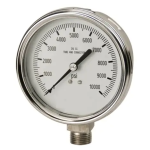
Shock resistant and highly corrosive stainless steel pressure gauge
Product Specification:
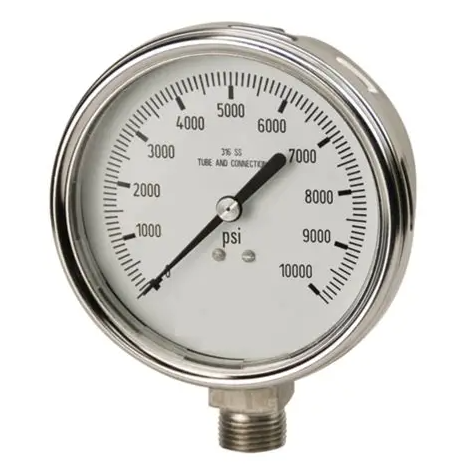
Product Name: 316 Stainless Steel Shock resistant Industrial Pressure Gauge
Range: 0-10000 psi (pounds per square inch)/approximately 0-690 bar/approximately 0-69 MPa
Material: 316 stainless steel Bourdon tube and liquid connection fittings.Surface protection: PC safety glass or polycarbonate
Process connection: 1/2 “NPT stainless steel joint (can be customized as needed)
Seismic option: Can be filled with glycerin or silicone oil (strongly recommended for pulsating work processes)
Protection level: IP65 (dustproof and waterproof)
Working temperature: ambient temperature: -20 ° C~+60 ° C; medium temperature: maximum+100 ° C (depending on the liquid filling)
Accuracy level: (based on typical industrial standards such as EN 837-1) ± 1.6% or higher
Industrial application: applicable to medium and high pressure and high corrosive working conditions in oil and gas, chemical industry, shipbuilding, water treatment and other industries.
Detailed product:
1. Excellent durability and environmental adaptability
This pressure gauge is designed specifically for harsh industrial environments. The core pressure bearing component – Boden tube and all process connection parts are made of high-quality 316 stainless steel (316 SS). Compared to ordinary 304 stainless steel, 316 stainless steel has better resistance to chloride corrosion and acid and alkali corrosion due to the addition of molybdenum element. It is particularly suitable for offshore platforms, chemical treatment, saltwater or corrosive media, ensuring long-term measurement stability and instrument longevity.
2. Accurate measurement and high intensity
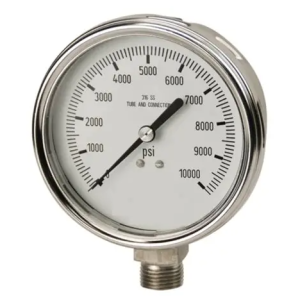
The range of up to 10000 psi (approximately 690 bar) indicates that this is a professional instrument designed for high-pressure applications. The dial scale is clear, the main and secondary scales are clearly divided, and the pointer points accurately (such as at the 3000 psi position), ensuring that the operator can quickly and accurately read the pressure value even at a long distance. The sturdy all metal casing and thick glass cover provide excellent mechanical protection against unexpected impacts and sustained vibrations.
3. High shock resistance and cost-effectiveness
The interior of the case can be filled with glycerin or silicone oil, which can effectively buffer the severe shaking of the pointer caused by system pressure pulsation or environmental vibration, prevent premature wear of the movement, maintain clear and stable readings, and significantly extend the service life of the instrument. Suitable for high-pressure application scenarios (often accompanied by pulsation of pumps, compressors, and other equipment).
4. Application scenarios
This instrument table is an ideal choice for the following high-pressure and corrosive operating conditions:
Oil and gas: wellhead equipment, throttling manifold, high-pressure water injection pump outlet, compressor stage and outlet, natural gas processing equipment.
Chemical and process industries: high-pressure reactors, synthesis towers, urea plants, and pipelines for transporting corrosive chemicals.
Energy and Electricity: Boiler Feedwater System, Steam Pipeline, High Pressure Heater.
Industrial equipment: hydraulic testing bench, pneumatic boosting system, high-pressure cleaning equipment.
Ship and Ocean Engineering: High pressure pumps for seawater desalination, hydraulic systems for deck machinery.
5. Safety and Compliance
The product design and manufacturing follow international industrial standards (such as ASME B40.1 or EN 837-1) to ensure its safety and interchangeability. And the NACE MR0175/ISO 15156 material conformity statement for acidic environments meets the stringent requirements for equipment safety in various engineering projects worldwide.
| Applicable industries and work pressure range | ||
| Industry/Application Scenarios | Range of application pressur(psi) | Instructions |
| Oil and Natural Gas | 2,000–6,000 psi | 10,000 psi。Drilling equipment, wellhead control, fracturing truck, high-pressure pipeline monitoring. The range is often as high as 10000 psi. |
| Chemical/Petrochemical | 1,000–5,000 psi | High pressure reactor, synthesis tower, and outlet of high-pressure compressor. The medium is often corrosive and requires stainless steel or special alloy materials. |
| Electricity/Energy | 800–3,500 psi | Boiler main steam pressure, high-pressure feedwater system, nuclear/thermal power high-pressure equipment. It needs to withstand high temperature and high pressure fluctuations. |
| Marine Engineering/Ships | 2,000–6,000 psi | Subsea valves, hydraulic control units, and underwater operation equipment. Requires resistance to seawater corrosion and high protection level. |
| Mining/Metallurgy | 1,500–4,500 psi | Hydraulic support, high-pressure water jet cutting, mining machinery hydraulic system. It needs to be resistant to impact and dust. |
| Aerospace/Military Industry | 1,000–5,000 psi | Hydraulic/fuel system, ground test bench. High precision, impact resistance, and corrosion resistance are required. |
| High pressure gas/industrial gas | 2,000–6,000 psi | Hydrogen/nitrogen/helium high-pressure storage tank, gas compressor outlet. Leak prevention and high security are required. |
| Industrial equipment | 1,000–3,500 psi | High pressure air compressor, hydraulic pump station, pressure testing bench. Seismic design and stable readings are required. |
FAQ:
Instrument pressure selection and specification category
Q: How to choose the appropriate pressure gauge for my application?
A: The selection needs to consider four core elements: pressure range, medium characteristics, environmental conditions, and functional requirements. It is usually recommended that the working pressure be between 1/3 and 2/3 of the range. For corrosive media, compatible materials (such as 316L, Hastelloy) or diaphragm seals must be selected.
Q: What does the precision level (such as ± 1.6%) on the dial mean?
A: It represents the maximum allowable basic error of the instrument. For example, a meter with a range of 0-100 bar and an accuracy of ± 1.6%, the error of any reading does not exceed ± 1.6 bar. Higher precision (such as ± 0.5%) means more accuracy, but the price is also higher.
Q: What are the types of process connection threads? How should I choose?
A: Common ones include NPT (American taper pipe thread), G (British parallel pipe thread), and M (metric thread). NPT is most commonly used in North America, relying on threaded sealing; G-threads are more common in Europe and Asia and typically require sealing gaskets. Choose to match your existing pipeline system.
Q: What is a “shock resistant” pressure gauge? Under what circumstances should it be used?
A: The shock resistant watch is filled with glycerin or silicone oil inside the case, which can effectively dampen the severe shaking of the pointer. It must be used in situations where there is continuous vibration or pressure pulsation, such as near pumps, compressors, and hydraulic systems, to protect the movement, improve readings, and extend lifespan.
Installation and maintenance of pressure instruments
Q: What are the key precautions when installing a pressure gauge?
A: Suitable isolation valves (such as needle valves) must be used for maintenance or replacement without affecting the process. Ensure appropriate tightening torque to avoid damaging threads due to over tightening. For high-pressure or pulsating applications, it is recommended to install pulse dampers or flow limiting holes near the pressure tap.
Q: What should I do if the pressure gauge pointer doesn’t move, bounces too much, or doesn’t return to zero?
A: Do not move: Check if the isolation valve is open and if the pressure tapping hole is blocked.
Large jumping: usually caused by system pressure pulsation, dampers should be installed or shock resistant filling gauges should be used instead.
Non zeroing: It may be due to internal movement jamming or overload damage. Minor offset can be corrected by a zeroing device (if equipped), otherwise it needs to be verified or replaced.
Q: Do pressure gauges need to be calibrated regularly? How long is the cycle?
A: Yes, regular calibration is crucial, especially for security monitoring or trade settlement. The calibration cycle depends on the importance of the application, environmental conditions, and frequency of use, typically ranging from 6 months to 2 years. It is recommended to follow the factory’s quality assurance system or relevant industry standards.
Q: Can I repair the pressure gauge myself?
A: Strongly not recommended. Pressure gauges are precision measuring and safety equipment. Non professional disassembly can damage its sealing, accuracy, and certification status, which may lead to leakage, measurement errors, and even safety accidents. If a malfunction occurs, it should be returned to the manufacturer or authorized service point for repair.
Ordering and Service Category
Q: Can special ranges, scales, or connection methods be customized?
A: Okay. Many manufacturers offer customized services, such as special pressure units (such as kgf/cm ²), dual dials, special process connections (flanges, clamps), customer logos, etc. Please confirm with the sales engineer before placing an order.
Q: How long is the product warranty period? What content is covered?
A: Typically, industrial pressure gauges come with a 12 to 24 month warranty, starting from the date of manufacture or delivery. The warranty covers material and process defects, but does not include damage caused by misuse, overpressure, corrosion, or failure to install according to the instructions.
Q: How to obtain detailed product certificates (material reports, calibration certificates, etc.)?
A: The product is usually accompanied by a certificate of conformity and a factory test report when it leaves the factory. Material Material Report (3.1 Material Certification) and third-party calibration/certification certificates may require additional ordering or explicit requirements during the inquiry process.
If you have any orders for shock resistant and highly coronal stainless steel pressure gauges, please contact DERKIA: sales@derkia.com