Working temperature: -20 ° C to+60 ° C (depending on the internal filling fluid).
This is the most widely used pressure gauge in oil fields, almost ubiquitous.
Core Features: The case is filled with damping fluids such as glycerin or silicone oil, equipped with a rubber diaphragm or piston-type membrane, which effectively buffers pulses and severe vibrations, prevents pointer jitter, extends service life, and facilitates reading.
Application:
Industrial sectors: Pressure monitoring in the petrochemical, power, water treatment, and pharmaceutical industries.
Mechanical equipment: air compressor, hydraulic system, cooling system, pump valve group.
Special environment: earthquake prone areas, ships, heavy vehicles, vibration testing platforms, etc.
Applicable media: Non corrosive media such as gases and liquids (if the liquid contact part is stainless steel or brass, it can be compatible with multiple media).
| Corresponding Table of Applicable Media and Pressure Range | ||
| Media type | (kgf/cm²) | Precautions |
| Compressed air | 2–10 | Regular drainage is required to prevent condensed water from entering the instrument |
| Water/coolant | 1–6 | Avoid water hammer impact and seal the interface properly |
| Water/coolant | 3–8(low pressure systerm) | Compatible with petroleum based oils (with stainless steel for the liquid receiving part) |
| Inert gas (nitrogen) | 0.5–8 | Pay attention to gas purity and avoid corrosive impurities |
Suggested instrument selection
1. Principle of range selection:
During normal operation, the pressure should be between 30% and 80% of the range (i.e. the 3-8 kgf/cm ² range on this gauge).
Avoid long-term use at ranges below 10% or above 90%, otherwise accuracy and lifespan will decrease.
2. Extreme stress scenarios:
If the pressure is close to 10 kgf/cm ² for a long time, it is recommended to upgrade and use a meter with a range of 0-16 kgf/cm ² or higher.
Under pulse pressure conditions (such as pump start stop), a pulse buffer can be installed to extend the lifespan of the instrument.
3. Environment matching:
Silicone oil filling is preferred for high temperature environments (>60 ° C); Avoid using glycerol filling in low temperature environments (<-5 ° C).
FAQ:
FAQ 1: What type of pressure gauge is this?
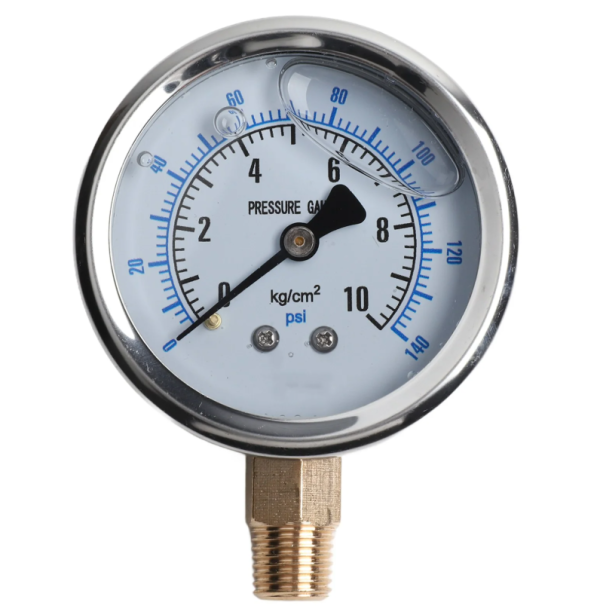
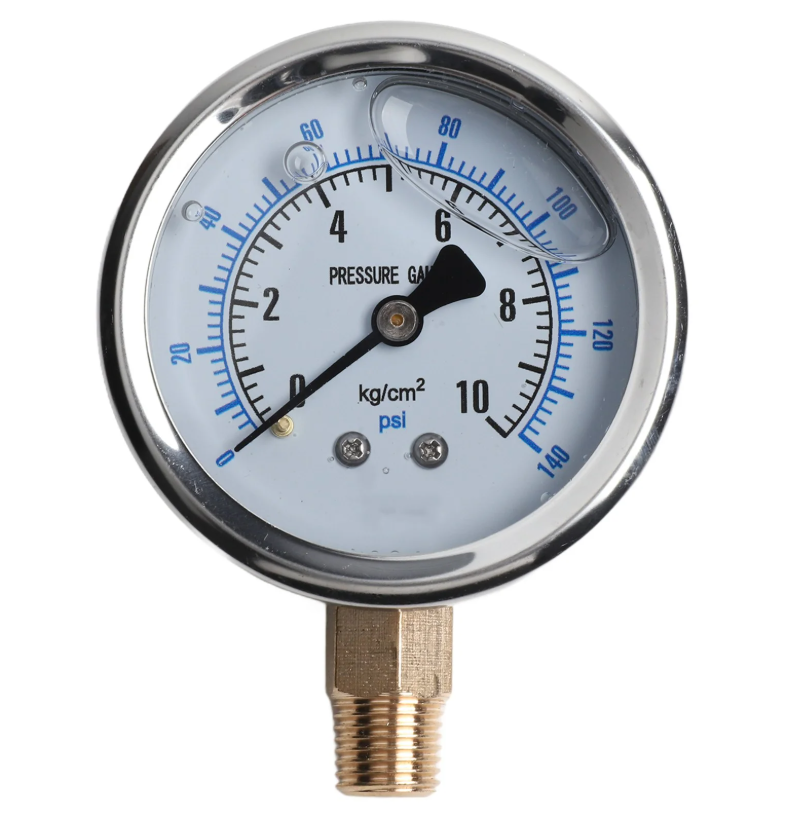
This is a seismic pressure gauge designed specifically for high vibration and high impact environments. The dial is labeled with “PRESSURE GAUGE” and features a white dial with dual tone markings. The structure is sturdy and typically comes with built-in liquid damping (such as glycerin) to reduce pointer shaking and ensure stable readings.
FAQ 2: What is the measurement range of a pressure gauge?
The range is 0-10 kgf/cm ² (kilogram force/square centimeter), corresponding to 0-142 psi (pound force/square inch) in British units. The inner ring of the dial has a kgf/cm ² scale and the outer ring has a psi scale, supporting dual unit direct reading.
FAQ 3: How to convert units “kgf/cm ²” and “psi”?
The conversion relationship is: 1 kgf/cm ² ≈ 14.22 psi
FAQ 4: What are the interface specifications?
The bottom is a standard metal threaded interface, with common specifications of G1/2 (metric) or 1/4 NPT (American), which need to be confirmed according to the actual product or product manual. The interface material is usually brass or stainless steel, which is corrosion-resistant and has good sealing performance.
FAQ 5: What is the accuracy of this pressure gauge?
The typical accuracy is ± 1.6% full scale (FS), and some models can reach ± 1.0%. Seismic design can still maintain stable readings in vibration environments, but regular calibration is recommended after long-term use.
FAQ 6: What are the measurable media?
Suitable for non corrosive gases or liquids such as air, water, hydraulic oil, etc. If the liquid receiving part is made of stainless steel or brass, it can be compatible with most neutral media; Corrosive media (such as strong acids, ammonia) require special materials (such as 316 stainless steel, Monel alloy) to be selected.
FAQ 7: What is the temperature range for use?
The general working temperature is -20 ° C to+60 ° C. The internal filling fluid (such as glycerin or silicone oil) may thicken at low temperatures, affecting the pointer response; Attention should be paid to preventing vaporization of the filling liquid or deformation of the surface mirror in high temperature environments.
FAQ8:How to choose the working temperature for filling glycerol and silicone oil?
Glycerol: -5 ° C to+60 ° C (conventional), easy to solidify, easy to oxidize above 80 ° C
Silicone oil: -40 ° C to+150 ° C (conventional), maintains fluidity, high temperature resistance and stability
It is obvious that the temperature range of silicone oil is significantly wider
If the pressure gauge is used in extreme high/low temperature environments (such as refrigeration equipment, boiler pipelines), silicone oil filling liquid can ensure stable pointer, non solidification, and non vaporization
Suggestion:
1.If the application environment temperature changes greatly or extremely, priority should be given to using silicone oil filled seismic pressure gauges.
2. In conventional indoor industrial environments (temperature -5 ° C~60 ° C), glycerol filling is sufficient and cost-effective.
FAQ 9: How to calibrate instruments?
Suggest comparing through professional calibration equipment (such as digital pressure calibrators):
Connect standard pressure source and pressure gauge;
Compare readings point by point (e.g. 0, 2.5, 5, 7.5, 10 kgf/cm ²);
If the error exceeds the tolerance, it needs to be adjusted by the manufacturer or professional organization. Users are not allowed to disassemble the internal movement by themselves.
FAQ 10: What are the precautions during installation?
1. Avoid overload: Ensure that the working pressure does not exceed 80% of the full range (i.e. ≤ 8 kgf/cm ²);
2. Reduce vibration: Install in a stable position as much as possible, or use flexible joints to cushion vibration;
3. Sealing treatment: The threaded interface needs to be wrapped with raw material tape or sealant to prevent leakage;
4. Vertical installation: The dial should face in a direction that is easy to read, avoiding tilting or inversion;
5. Regular inspection: In severe vibration environments, it is recommended to check the flexibility and appearance integrity of the pointer every 3-6 months.