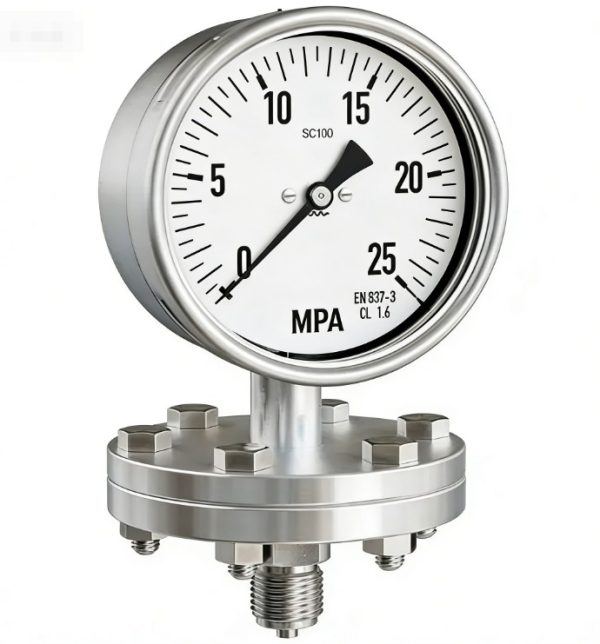
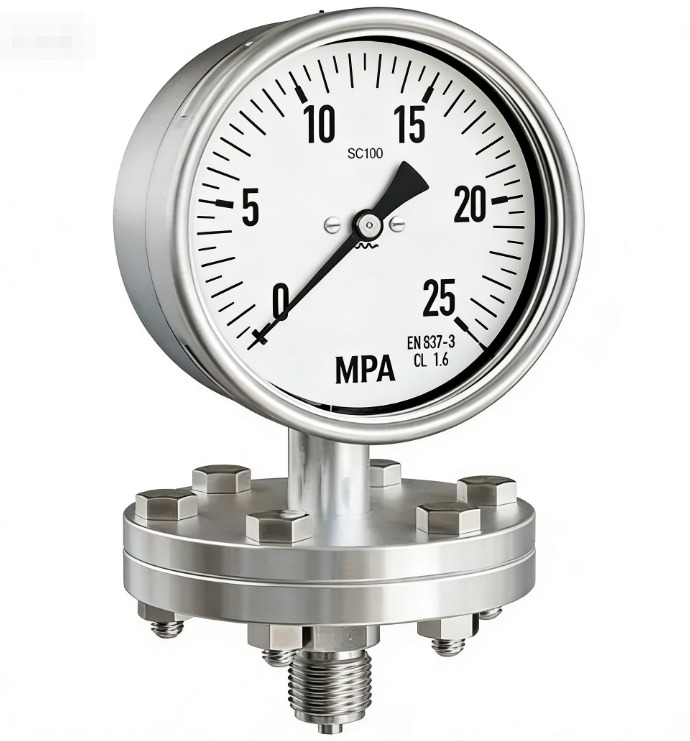
SC100 Diaphragm-sealed shock-resistant Seismic-Filled pressure gauge
This SC100 shock resistant diaphragm pressure gauge is a universal instrument for medium and high pressure monitoring in the industrial field
| Technical parameter analysis | Specification |
| Range of measurement | 0-25 MPa (approximately 0-250 bar or 0-3625 psi) |
| Unit | MPa (megapascals, commonly used in hydraulic systems, petrochemicals, and energy industries) |
| Media compatibility | The silver shell is usually made of stainless steel (such as SS304/316) and is suitable for water, oil, steam, and general corrosive media |
| Seismic performance | The dial is filled with liquid (glycerin or silicone oil), which can reduce pointer shaking and is suitable for vibration scenarios such as pumps and compressors |
| Interface | Bottom threaded interface (commonly G1/2, M20 × 1.5 or NPT 1/2, to be confirmed according to on-site use) |
| Environmental protection | Equipped with IP65 protection level (dustproof and waterproof), suitable for outdoor or harsh environments |
| Security redundancy | The dial usually comes with a safety relief hole or explosion-proof design |
Industrial applications
1. Oil and gas industry
Can be used for pressure monitoring of water/steam injection pipelines and monitoring of wellhead auxiliary equipment for heavy oil extraction (with a range of 25 MPa covering most medium and high pressure scenarios). For example, the Orinoco heavy oil belt in Venezuela and the Athabasca oil sands in Canada. The Manifa oil field in Saudi Arabia, the Lauzatein oil field in Kuwait, the Mukazna oil field in Oman, and the West Siberian oil field in Russia, among others.
2. Chemical and process industries
Measurement of reactor pressure, hydraulic system, and compressor outlet pressure (ensuring compatibility of the medium with stainless steel material).
For example, diaphragm sealed explosion-proof type is preferred for reactor pressure, emphasizing corrosion resistance and safety. The hydraulic system focuses on shock resistance and response speed, making it very suitable for selecting the type of filling fluid. The selection of compressor outlet requires anti pulsation design, combined with seismic resistance meter and damping transmitter.
3. Electricity and Energy
Boiler water supply system, thermal pipeline (shock resistant design suitable for steam pulsation environment).
4. General mechanical equipment
Hydraulic station, injection molding machine, pressure testing bench, etc.
Procurement Advice
Confirmation Matters
Interface size: Verify the bottom thread specification (usually G1/2 “) to avoid installation mismatch.
Medium temperature: Confirm the type of filling fluid (silicone oil resistant to high temperatures>150 ° C, glycerin suitable for room temperature).
Explosion proof requirement: If used in flammable and explosive areas (such as oil fields, chemical plants), ATEX/IECEx explosion-proof certification models need to be selected (not shown in the figure, additional confirmation is required).
Merchants can recommend benchmark (stainless steel shock resistant meter) or (economical liquid filled meter).
Maintenance and Installation Points
It is recommended to install pulse dampers (to cope with frequent pressure shocks) or heat dissipation bends (for high-temperature steam applications) during installation.
Regular calibration (recommended every 6-12 months) to prevent accuracy drift.
FAQ for Stainless Steel Shock resistant Liquid filled Pressure Gauge
Q1: What is a “stainless steel shock resistant liquid filled pressure gauge”?
A: The industrial pressure measuring instrument is made of stainless steel for the watch case and main components, and filled with damping liquids such as glycerin or silicone oil in the chamber. The liquid buffers mechanical vibration and pressure pulsation to ensure stable reading of the pointer.
Q2: What is the main function of liquid filling?
A:Shock absorption and damping: absorb equipment vibration and medium pulsation to prevent pointer shaking.
Lubrication and anti-corrosion: reduce gear wear, prevent internal fogging and frosting.
Heat dissipation and cooling: Some filling liquids (such as silicone oil) can help dissipate heat.
Q3: How to choose glycerol and silicone oil filling solution?
Glycerin: Universal type (-5 ℃~+50 ℃), high cost-effectiveness, not resistant to high temperatures.
Silicone Oil: With a wide temperature range (-40 ℃~+200 ℃), it is suitable for high or low temperature environments and has a high cost.
Q4:How to choose the appropriate range?
A: The standard operating pressure should be within the range of 25% to 75% of the measuring range.
The maximum working pressure shall not exceed 2/3 of the range.
The peak pressure shall not exceed 3/4 of the measuring range.
Example: The actual pressure is 10 MPa. It is recommended to choose a range of 0-16 MPa or 0-25 MPa.
Q5: What are the precautions during installation?
A: Vertical installation: The dial should face the operator vertically to avoid reading errors caused by tilting.
Shock absorption measures: If the vibration is strong, rubber pads or spring brackets can be installed.
Pulse protection: When the medium pulsation is large, a damping valve or buffer pipe should be installed in front of the interface.
High temperature protection: For measuring steam or high-temperature media (>80 ℃), a siphon tube (condenser bend) needs to be installed.
Anti blocking design: For measuring viscous media, membrane isolation type or models with flushing interfaces should be selected.
Q6: What is the impact of ambient temperature on the filling meter?
A:Excessive temperature (>upper limit of filling liquid): Liquid expansion may break the glass of the meter or cause reading deviation.
Low temperature (<lower limit of filling liquid): The liquid solidifies and thickens, and the pointer responds slowly.
Solution: Choose wide temperature silicone oil (-40 ℃~+200 ℃) or install external insulation/heat dissipation fins.
A:Standard stainless steel (304/316) is not suitable for strong corrosive media!
Special materials need to be selected:
Diaphragm: Hastelloy C276, Tantalum
Liquid receiving part: PTFE coating
Be sure to provide the chemical name and concentration of the medium to the supplier for confirmation.
A: Confirm with the supplier to select a sanitary pressure gauge:
The material meets FDA standards, and the interface uses Tri Clamp or SMS quick release clamps.
The filling liquid requires food grade glycerin (such as WIKA’s “Food Industry Type” series).
Smooth surface without dead corners, capable of CIP (online cleaning) sterilization.
A: Confirm with the supplier to select the ocean engineering grade type:
Shell material: 316 stainless steel or coated with Teflon.
Protection level: IP66/IP67 (anti strong water spray/short-term immersion).
Internal anti salt spray: Choose low-temperature resistant silicone oil as the filling fluid (to prevent solidification in winter).
A::Comparison method: Conduct parallel testing using a calibrated portable pressure calibrator.
Zero point check: Check if the pointer returns to zero after shutting down and releasing pressure (if it does not return to zero, it may be due to the movement being stuck or a problem with the balance spring).
Pipeline inspection: Check for leaks, blockages, or accumulation of condensate in the pressure conduit.