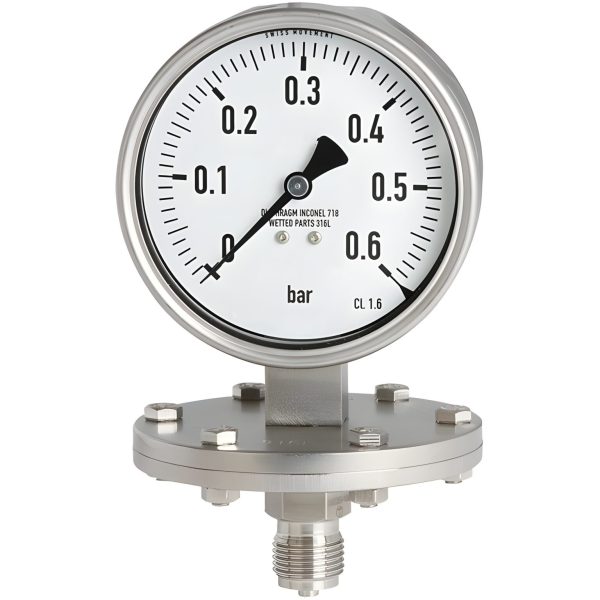
Core Features: The measurement medium is isolated from the pressure gauge mechanism via a diaphragm isolation device. The diaphragm material can be selected based on the corrosiveness of the medium (e.g., Hastelloy, tantalum, PTFE lining, etc.). It is particularly suitable for highly viscous, easily solidifying, crystallizing, or extremely corrosive media.
Application scenarios:
Measurement of heavy oil, asphalt, slurry, chemical agents, and the like.
Food-grade and hygienic requirements (e.g., oilfield additive injection systems).
Material and Structure
Material of liquid receiving components: WETTED PARTS 316L
316L stainless steel is an ultra-low carbon austenitic stainless steel with excellent corrosion resistance, especially able to withstand the corrosion of chlorides and sulfuric acid. This makes it suitable for corrosive environments such as seawater, chemicals, food, pharmaceuticals, etc.
Core sensing element material: C Ø NE INCONEL 718
Nickel chromium alloy with high strength, high temperature resistance, fatigue resistance, and oxidation resistance. Capable of withstanding harsh working conditions such as high pressure, high temperature, and high pulsation, while maintaining excellent long-term stability.
The interface and installation method adopt stainless steel flange installation instead of the traditional threaded direct screw in type. The flange has multiple bolt holes, which can achieve stable flat sealing installation, better withstand vibration and pulsation, and facilitate installation on panels or equipment.
Application:
Petrochemical and natural gas: monitoring filter differential pressure, flare head back pressure, nitrogen sealing system pressure, and low-pressure gas pipelines.
Offshore platforms and ships: resistant to seawater corrosion, used for pressure monitoring of ballast tanks, fuel systems, and ventilation systems.
Food and beverage and pharmaceutical: 316L stainless steel material meets hygiene standards and can be used for low-pressure pneumatic control of CIP (in-situ cleaning) systems, fermentation tank pressure, and sterile filling lines.
Electricity and Energy: Differential Pressure of Gas Turbine Inlet Filter, Micro Negative Pressure of Boiler Furnace, Low Pressure Monitoring of Desulfurization and Denitrification System.
Water treatment and environmental protection: monitor the suction pressure of pumps, filter blockage (through differential pressure), and aeration system pressure.
HVAC and cleanroom: Control supply/return air pressure, maintain room positive/negative pressure.
FAQ:
1. Question: What is the accuracy CL 1.6 of this pressure gauge?
Answer: “CL 1.6” means an accuracy level of 1.6, which is the higher precision level among industrial pressure gauges. At full scale (0.6 bar), the maximum allowable error is ± 1.6% FS, which is ± 0.0096 bar. This means that the repeatability and accuracy of the measurement results are good, suitable for situations where precise monitoring of micro pressure is required.
2. Question: What does the “WETTED PARTS 316L” label on the dial mean?
Answer: This means that the liquid receiving components of the pressure gauge (i.e. all internal parts that come into contact with the measured medium, such as spring tubes, joints, movements, etc.) are made of 316L stainless steel material. 316L is a low-carbon austenitic stainless steel with excellent corrosion resistance, especially suitable for measuring corrosive gases, liquids, or industries with hygiene or corrosion resistance requirements such as food, pharmaceuticals, and chemicals.
3. Question: What does “CONE INCONEL 718” refer to?
Answer: This refers to the core sensing element of the pressure gauge – the Bourdon tube (or spring tube), which is made of Inconel 718 alloy. This is a high-performance nickel based alloy with extremely high strength, excellent fatigue resistance, good high temperature resistance, and corrosion resistance. The use of this material means that the pressure gauge can withstand higher overpressure, stronger pulsating impact, and more harsh medium environments, ensuring long-term stability and service life.
4. Question: What pressure can be measured with a range of 0.6 bar?
Answer: The measurement range of this meter is from 0 to 0.6 bar. 1 bar is approximately equal to 0.1 megapascals (MPa) or 14.5 psi. This is a micro pressure range that is very suitable for measuring low pressure scenarios such as static/dynamic pressure in ventilation systems, pneumatic control signals, filter pressure differentials, combustion chamber micro positive pressure, bioreactor tank pressure, and clean room pressure differentials.
5. Question: How is it installed? What are the functions of the central circle of bolts and the threaded interface at the bottom?
Answer: This watch adopts a flange installation.
A central ring of bolts: used to firmly fix the flange of the pressure gauge on the installation panel or equipment, providing the main mechanical support and effectively resisting vibration.
Bottom threaded interface: This is a pressure interface (such as G1/4, M20 * 1.5, etc.) used to connect pressure pipelines of the tested system. Suitable sealing materials (such as gaskets or tape) should be used during installation to ensure no leakage.
6. Question: What medium is it suitable for measuring?
Answer: With 316L stainless steel liquid receiving parts and Inconel 718 Bourdon tube, it can safely measure various media, including:
1. Non corrosive gases such as air, nitrogen, oxygen, etc.
2. Water and hydraulic oil.
3. Gases or liquids with slight corrosiveness (such as media containing small amounts of acid, alkali, and chloride).
4. In the food and pharmaceutical industries, it can be used in situations where it comes into contact with products or cleaning media.
7. Question: With such high accuracy, how often does it need to be calibrated?
Answer: The calibration cycle depends on the frequency of use, environmental conditions, and process requirements. Suggestion:
When used for critical process control or safety monitoring: calibrate every 6 to 12 months.
2. For general instructions or non critical occasions: can be extended every 12 to 24 months.
In environments with severe vibrations, large temperature fluctuations, or measuring corrosive media, the calibration cycle should be shortened. Calibration must be carried out by qualified institutions or using higher-level standards.
8.Question: What is the temperature range of its working environment?
Answer: The working environment temperature range of a typical industrial pressure gauge is about -20 ° C to+60 ° C. The medium temperature (fluid temperature transmitted through the pressure interface) is usually allowed to be higher, possibly up to+100 ° C. Please refer to the product manual for details. High or low temperatures may affect accuracy.
9. Question: Can the pointer be repaired if it is damaged or not reset to zero?
Answer: It can be repaired, but it is recommended to have it done by professionals. Repairs may involve internal movement adjustments, pointer reinstallation, or replacement. Due to its high precision and special materials, non professional operations can easily lead to permanent accuracy loss or damage to core components. Usually, returning to the factory for repair or replacement is a more reliable option.
10. Question: What are its core advantages compared to ordinary pressure gauges?
Answer: The core advantage lies in the trinity of “high precision, corrosion resistance, and sturdy structure”:
High precision (CL1.6): Provides more reliable data for precise control and monitoring.
All stainless steel+Inconel material: capable of corrosive environments, long service life, and low maintenance costs.
Flange installation: Good seismic resistance, stable installation, suitable for industrial sites.
It is a professional instrument designed for precise micro pressure measurement in harsh industrial environments.