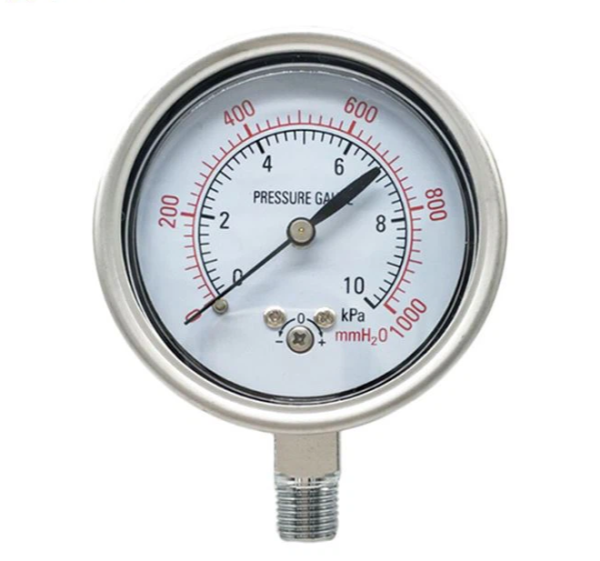
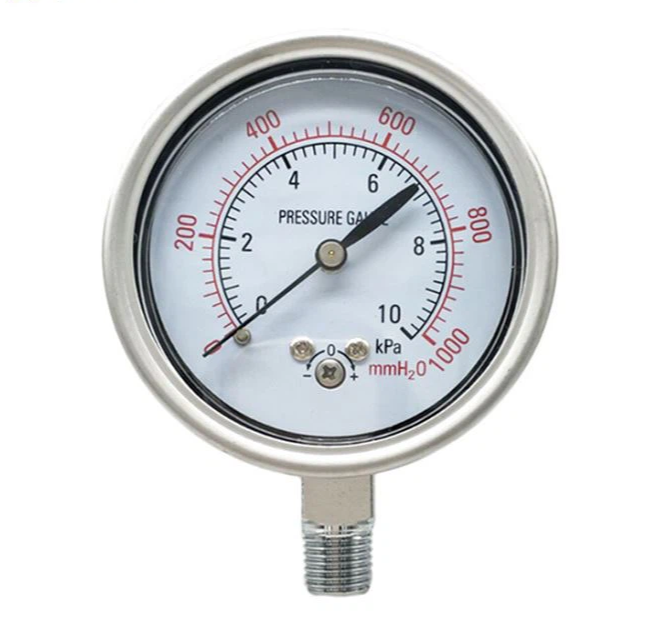
Low pressure range: 0~0.1 MPa to 0~2.5 MPa (similar to full plastic type).
Medium and high pressure range: 0~4.0 MPa to 0~60 MPa or even higher.
Working temperature: -20 ° C~+60 ° C
Medium temperature: Standard model up to 80 ° C; with radiator or remote transmission device, it can reach above 200 ° C
Core Features: The contact liquid components (such as connectors and Bourdon tubes) are made of stainless steel (e.g., 316, 316L) or coated with anti-corrosion materials (e.g., Hastelloy, Monel alloy, tantalum). For highly corrosive media (e.g., hydrogen sulfide, acidic gases), sulfur-resistant pressure gauges must be used.
Application scenarios:
Sulfur-containing acidic oil and gas fields: Mandatory use of sulfur-resistant materials to prevent sulfide stress corrosion cracking.
Chemical process, seawater injection system.
Measurement separator: Contact with multiphase mixtures such as oil, gas, water, and sand.
Main product series and application selection
Series Name |
Core materials/technology |
Typical application media |
Advantage |
Applicable Industries |
| Standard anti-corrosion type | Liquid receiving part: 316L stainless steel; Case: 304 stainless steel or plastic | Weak to moderately corrosive media, such as seawater, weak acids, alkaline solutions, and steam | High cost-effectiveness and strong universality | General Industry, Water Treatment, HVAC, Shipbuilding |
| Full plastic type | Case, connector, movement cover: PP/PVDF/PTFE; Core: 316L or all plastic | Strong acid, strong alkali, chlorine gas, bromine gas and other halogen media | Lightweight, low cost, and excellent resistance to chemical corrosion“ | Chemical industry, electroplating, wet metallurgy, semiconductor cleaning |
| Diaphragm isolation type | Isolation membrane (tantalum/titanium/Hastelloy/PTFE)+filling fluid system“ | Any medium with strong corrosion, high viscosity, easy solidification, and containing solid particles | Highest level of anti-corrosion, protecting the core movement and easy maintenance“ | Petrochemical, fine chemical, pharmaceutical, food, and slurry measurement“ |
| Alloy special type | The overall or liquid receiving parts are made of Hastelloy, Monel, and titanium | High temperature concentrated sulfuric acid, hydrochloric acid, wet chlorine gas, acetic acid, hydrofluoric acid (limited), etc | Suitable for high temperature, high pressure, and extreme corrosive environments | Specialty chemicals, chemical fibers, acetic acid engineering, offshore platforms |
| Hygienic | 316L stainless steel polished, EP/ Ra<0.8μm, Three clip clamp connection, high precision | Corrosive foods, drugs, and biologics | Compliant with hygiene standards, easy to clean and sterilize | Pharmaceutical, food, beverage, biotechnology |
Applicable for different types of pressure ranges
| Micro pressure/low pressure | 1 ~ 0 bar (vacuum) 0 ~ 0.6 bar 0 ~ 4 bar |
Absorption tower, ventilation system, bioreactor (controlling culture pressure). Filter tank and water tank liquid level (measured by pressure). This type of pressure requires high sensitivity for diaphragm isolation systems. |
| Medium voltage (most commonly used) | 0 ~ 10 bar 0 ~ 16 bar 0 ~ 25 bar 0 ~ 40 bar |
The vast majority of chemical process flows, pump outlet pressures, and pipeline pressures. Water treatment dosing system, food and beverage processing line. This is the mainstream and most cost-effective range range for diaphragm isolation and full plastic pressure gauges. |
| High pressure | 0 ~ 100 bar 0 ~ 250 bar 0 ~ 400 bar (even higher) |
High pressure reactor, synthesis process, hydraulic system (using corrosion-resistant hydraulic oil), subsea pipeline. Technical key: The higher the pressure, the more stringent the requirements for the pressure resistance and sealing design of the isolation diaphragm, and the significantly higher the cost. Commonly used in the fields of specialty chemicals and energy. |
| Ultra-high pressure | Above 400 bar | Special chemical synthesis (such as polyethylene), water jet cutting, oil and gas extraction. In this field, the priority of structural strength and safety is usually higher than corrosion prevention, and special alloy integral forging of liquid receiving components or the use of dual isolated remote sealing systems are usually adopted. |
How to choose and order?
When selecting, please provide the following information to ensure that the instrument is suitable:
1. Measurement medium: Determine the specific chemical name, concentration, and temperature.
2. Pressure range: Confirm the commonly used working pressure and maximum pressure.
3. Process connection: thread specification, material, installation direction.
4. Environmental conditions: ambient temperature, whether it is outdoors, whether there is vibration, and whether there is a risk of explosion (explosion-proof requirements).
5. Special requirements: dial unit, accuracy, and whether it comes with shock-absorbing oil?
6. What post production services and support are needed.
FAQ (Corrosion resistant Pressure Gauge)
Q1: Under what circumstances must a corrosion-resistant pressure gauge be used?
A: When the tested medium is a chemically corrosive gas or liquid such as acid, alkali, salt solution, organic solvent, chlorine gas, ammonia gas, seawater, wet chlorine gas, etc., it must be used. If a regular pressure gauge is used, its internal copper alloy or carbon steel components will quickly corrode, leading to instrument failure, leakage, and even safety accidents.
Q2: Is stainless steel (such as 304/316) pressure gauge a universal corrosion-resistant choice?
A: No, it’s not. 304/316 stainless steel has good corrosion resistance to many media, high cost-effectiveness, and is a universal choice. But it is not omnipotent, for example:
1. Limited corrosion resistance to reducing acids such as hydrochloric acid and sulfuric acid.
2. Pitting corrosion or stress corrosion cracking may occur in environments containing chloride ions, such as seawater.
3. For these more corrosive media, it is necessary to choose pressure gauges made of all plastic (PP/PVDF), tantalum, Hastelloy alloy, or using diaphragm isolation technology.
Q3: What is the essential difference between diaphragm isolation pressure gauges and direct contact pressure gauges? How should I choose?
A:
1. Direct contact type: The medium directly enters the instrument measuring mechanism (such as a Bourdon tube). Suitable for clean, non corrosive or weakly corrosive media.
2. Diaphragm isolation type: The medium only contacts a corrosion-resistant diaphragm and transmits pressure through the filling liquid. This is the preferred solution for dealing with strong corrosion, high viscosity, easy crystallization, or media containing solid particles.
Suggestion for selection: When you are unsure about the compatibility of the medium or if the medium will cause pollution or damage to the measuring institution, prioritize the diaphragm isolation type. Although it has a slightly higher cost, it can protect the instrument core to the greatest extent possible, extend its service life, and make maintenance safer and more convenient.
Q4: How to determine which anti-corrosion material is suitable for my medium?
A: The most reliable method is to refer to the material corrosion data manual or consult the engineer of the instrument supplier. You need to provide accurate chemical name, concentration, temperature, and pressure of the medium. For example:
1. Dilute sulfuric acid: 316L stainless steel is optional.
2. Concentrated sulfuric acid (room temperature): Carbon steel or stainless steel can be selected, but Hastelloy alloy should be used for hot concentrated sulfuric acid.
3. Hydrochloric acid: PTFE (Teflon), tantalum, or all plastic materials are usually required.
4. Wet chlorine gas: Tantalum or special alloys are usually used.
Q5: Can a corrosion-resistant pressure gauge be used to measure corrosive gases?
A: Sure, but special attention needs to be paid. Corrosive gases such as chlorine, sulfur dioxide, and hydrogen sulfide may also be corrosive to non liquid parts such as watch cases and lenses. At this point, you should choose:
1. Fully sealed structure (high protection level IP65/67).
2. The material of the watch case also needs to be corrosion-resistant (such as all stainless steel or plastic casing).
3. For highly toxic or hazardous gases, it is strongly recommended to use membrane isolation type and ensure absolute sealing at the connection.
Q6:Why are some corrosion-resistant pressure gauges filled with liquid (such as glycerin or silicone oil) inside?
A: This is a shock resistant pressure gauge. The function of filling fluid is to:
1. Damping and shock absorption: Lubricate the movement, buffer the pulsation of the medium and external mechanical vibration, prevent the pointer from shaking violently, improve reading stability and instrument life.
2. Preventing internal corrosion: It can isolate humid air and protect internal precision components from trace amounts of corrosive gases invading.
Application: Highly recommended for use on pump outlets, compressors, equipment with high vibration, or pipelines with pressure fluctuations.
Q7: What are the necessary precautions when installing a corrosion-resistant pressure gauge?
A:
1. Avoid direct installation: When possible, it is recommended to install through buffer tubes (siphon tubes) or chemical seals to avoid direct impact of high-temperature media on the instrument.
2. Appropriate torque: When tightening the connection, please use appropriate tools to avoid excessive force that may cause thread slippage or damage to the sealing surface.
3. Reserved maintenance space: The installation location should be easy to observe, verify, and maintain.
4. Correct direction: For a liquid filled meter, make sure the dial is facing upwards to avoid bubbles from the filling liquid affecting the reading.
Q8: Do corrosion-resistant pressure gauges need regular maintenance? How long is the maintenance cycle?
A: I need it. Regular maintenance is the key to ensuring its long-term accuracy and reliability. Suggestion:
1. Daily inspection: Observe the appearance for severe corrosion, leakage, whether the pointer is reset to zero, and whether the dial glass is clear.
2. Regular calibration: Based on the importance of the process and usage conditions, zero point inspection and accuracy calibration are usually performed every 6 to 12 months.
3. Preventive replacement: For strong corrosion or critical safety applications, even if the instrument is not damaged, preventive replacement should be considered according to the service life cycle (such as 1-2 years)
Q9: If the pressure gauge shows inaccurate readings or the pointer does not return to zero, what could be the reason?
A: Possible reasons include:
1. Internal corrosion: The liquid receiving components are corroded by the medium, causing elastic failure or blockage of measuring elements (such as Bourdon tubes).
2. Diaphragm damage/fatigue: Isolation diaphragm rupture or permanent deformation, resulting in pressure transmission failure or filling fluid leakage.
3. Wear or jamming of the movement: affected by vibration or crystallization of the medium.
4. Overload/pressure shock: The pressure frequently exceeds the upper limit of the range, causing permanent deformation of the internal mechanism.
5. Handling: Immediately stop using and replace, do not disassemble or repair on your own, especially for liquid filled or isolation diaphragm meters.
Q10: Can I customize corrosion-resistant pressure gauges with special ranges, special interfaces, or electronic signal outputs?
A: Absolutely possible. Professional suppliers of corrosion-resistant pressure gauges typically offer flexible customization services
1. Output signal: It can be equipped with 4-20mA two-wire system, HART protocol, switch alarm and other electrical signal outputs to achieve remote monitoring.
2. Special interfaces: Flanges, clamps, quick couplings, etc. can be customized according to equipment requirements.
3. Special range: Customization of non-standard range is provided.
4. Certification: Explosion proof (Ex d/Ex ia), marine (DNV/GL), sanitary (3A/EHEDG) and other certifications can be provided as needed.
When inquiring with DERKIA official, please provide detailed information on your specific working conditions and customization requirements.
sales@derkia.com