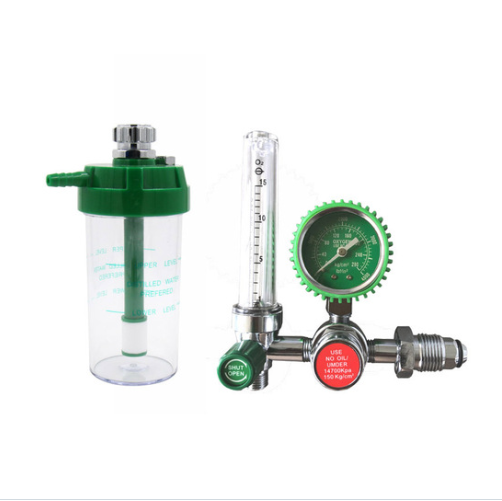
Name: Brass oxygen regulator for oxygen cylinder
Flow Rate:1-10LPM/1-15LPM
Inlet Pressure: 15Mpa
Outlet Pressure:0.2-0.3Mpa
Inlet Connector: Bull Nose
Accessory: Humidifier bottle, Nasal oxygen tube
Usagei Reducing oxygen cylinder pressure and control flow
OEM/ODM service
Warranty: 1 year
Inlet Pressure: 15Mpa
Outlet Pressure:0.2-0.3Mpa
Inlet Connector: Bull Nose
Accessory: Humidifier bottle, Nasal oxygen tube
Usagei Reducing oxygen cylinder pressure and control flow
OEM/ODM service
Warranty: 1 year
FAQ:
Compatibility & Installation
Q: Can this pressure regulator be connected to my oxygen cylinder? (Interface issue)
A: Please confirm the type of valve interface for your oxygen cylinder. We offer multiple standard interfaces, such as American standard CGA 540 (medical oxygen) DISS 1240、 European standard BS3, or thread specifications such as G5/8, W21.8. Please make sure to confirm the interface model when placing an order or in the product specification sheet. Connecting the wrong interface may result in leakage or danger.
Q: Can this pressure regulator be connected to my oxygen cylinder? (Interface issue)
A: Please confirm the type of valve interface for your oxygen cylinder. We offer multiple standard interfaces, such as American standard CGA 540 (medical oxygen) DISS 1240、 European standard BS3, or thread specifications such as G5/8, W21.8. Please make sure to confirm the interface model when placing an order or in the product specification sheet. Connecting the wrong interface may result in leakage or danger.
Q: What are the installation steps? What are the key precautions?
A:Ensure that the gas cylinder valve and pressure regulator interface are clean and free of grease.
Using a suitable wrench, align the thread with your hand and screw it in to avoid misalignment.
Fully tighten to ensure airtightness, but do not apply excessive force.
Before connecting downstream devices such as ventilators, humidification bottles, and welding guns, the pressure regulator knob should be loosened counterclockwise to the closed position.
Slowly open the main valve of the gas cylinder, check the pressure gauge reading and whether the interface is leaking (leak detection liquid can be used).
A:Ensure that the gas cylinder valve and pressure regulator interface are clean and free of grease.
Using a suitable wrench, align the thread with your hand and screw it in to avoid misalignment.
Fully tighten to ensure airtightness, but do not apply excessive force.
Before connecting downstream devices such as ventilators, humidification bottles, and welding guns, the pressure regulator knob should be loosened counterclockwise to the closed position.
Slowly open the main valve of the gas cylinder, check the pressure gauge reading and whether the interface is leaking (leak detection liquid can be used).
Q: What types of gases can it be used for? (Key issue)
A: The pressure regulator must be dedicated! This model is only used for oxygen. It is absolutely prohibited to mix with other gases (such as acetylene, propane, nitrogen), as mixing can cause internal pollution and trigger extremely dangerous chemical reactions (especially with flammable gases).
A: The pressure regulator must be dedicated! This model is only used for oxygen. It is absolutely prohibited to mix with other gases (such as acetylene, propane, nitrogen), as mixing can cause internal pollution and trigger extremely dangerous chemical reactions (especially with flammable gases).
Operation&Maintenance
Q: How to adjust the output pressure?
A: Rotate the adjustment knob clockwise, and the reading on the outlet pressure gauge will increase; Rotate counterclockwise and the pressure will decrease. Please adjust slowly and observe the requirements of downstream equipment.
Q: How to adjust the output pressure?
A: Rotate the adjustment knob clockwise, and the reading on the outlet pressure gauge will increase; Rotate counterclockwise and the pressure will decrease. Please adjust slowly and observe the requirements of downstream equipment.
Q: What do the two pressure gauges display respectively?
A: A high-pressure gauge (usually with a large range) displays the stored pressure inside the gas cylinder, representing the remaining gas volume. The low pressure gauge (usually with a small range) displays the working pressure you are adjusting the output. When the high-pressure gauge approaches zero, the gas cylinder needs to be replaced.
A: A high-pressure gauge (usually with a large range) displays the stored pressure inside the gas cylinder, representing the remaining gas volume. The low pressure gauge (usually with a small range) displays the working pressure you are adjusting the output. When the high-pressure gauge approaches zero, the gas cylinder needs to be replaced.
Q: Do pressure reducers need regular maintenance or calibration?
A: Yes, it is. To ensure accuracy and safety, it is recommended to have professional personnel conduct regular (such as annual or biennial) inspections and calibrations based on usage frequency and industry standards. If the pressure gauge is found to be inaccurate, leaking, not functioning properly, or frozen, it should be immediately stopped from use and sent for inspection.
A: Yes, it is. To ensure accuracy and safety, it is recommended to have professional personnel conduct regular (such as annual or biennial) inspections and calibrations based on usage frequency and industry standards. If the pressure gauge is found to be inaccurate, leaking, not functioning properly, or frozen, it should be immediately stopped from use and sent for inspection.
Q: What should be noted after use or long-term storage?
A: Close the main valve of the gas cylinder and open the downstream equipment to release the residual pressure in the pipeline until both pressure gauges return to zero. Then turn the adjustment knob counterclockwise to release the spring pressure and extend the lifespan of the diaphragm. Store in a dry, non corrosive gas environment.
A: Close the main valve of the gas cylinder and open the downstream equipment to release the residual pressure in the pipeline until both pressure gauges return to zero. Then turn the adjustment knob counterclockwise to release the spring pressure and extend the lifespan of the diaphragm. Store in a dry, non corrosive gas environment.