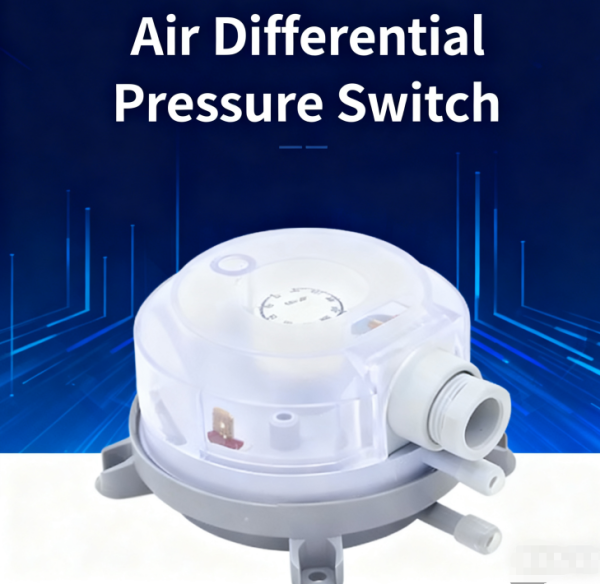
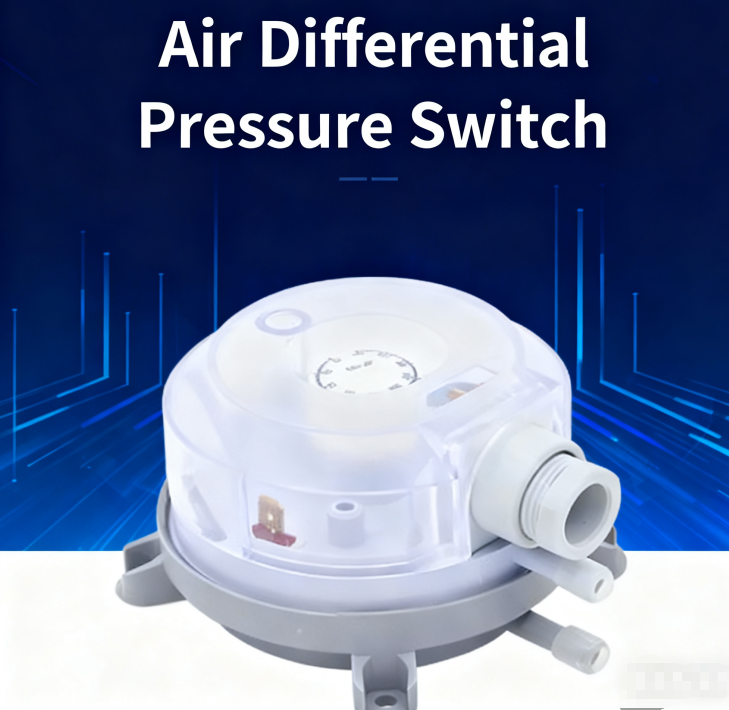
| Model | Air Differential Pressure Switch |
| Medium Air | non-combustible and non-aggressive gasses |
| Max Pressure | 10 kPa |
| Mounting position | Diaphragm in any vertical plane |
| Protection degree | IP54/IP65 (with cover) |
| Temperature | 40° C to 85° C |
| Contact | SPDT |
| Electrical Rating | 1.5A (0.4A) / 250V |
| Terminals | 6.3 mm(0.25″) copper alloy |
| Connection | 6.0mm Dia |
| Approval | CE/ISO9001 |
| Model | Pressure Rang | Differential | Toleranc |
| Pa | 20 ~ 200 Pa | 10 Pa | ±15% |
| Pa | 30 ~ 300 Pa | 10 Pa | ±15% |
| Pa | 40 ~ 400 Pa | 20 Pa | ±15% |
| Pa | 50 ~ 500 Pa | 20 Pa | ±15% |
| Pa | 200 ~ 1000 Pa | 100 Pa | ±15% |
| Pa | 500 ~ 2500 Pa | 150 Pa | ±15% |
Common protection levels:
IP54: Dustproof (limited intrusion) and splash proof. Suitable for most indoor industrial environments.
IP65: Completely dust-proof and water-resistant. It is a common high standard in industrial environments and can be used for spray cleaning or outdoor environments.
IP67: Completely dustproof and can be briefly immersed in water. Suitable for more demanding environments.
Classification: The protection level directly determines the operating environment of the switch. Ordinary distribution boxes can use IP54, while damp and dusty sites require IP65 or higher.
1.Function: The differential pressure switch sets a pressure difference of “filter needs to be replaced”. When the actual pressure difference exceeds this value, the switch will activate, triggering the alarm light or prompt message on the control panel, reminding the staff to replace the filter in a timely manner to ensure system efficiency and air quality.
Monitoring of fan operation status:
Principle: When the fan is running normally, it will establish a stable pressure in the system.
Function: The differential pressure switch is used to confirm whether the fan has started and is running normally. If the fan malfunctions or the belt breaks, the pressure will disappear and the differential pressure switch will send a fault signal.
2. Process control
Utilize pressure difference to precisely control the process flow.
Boiler furnace pressure safety control:
Principle: The boiler requires stable induced draft, and the internal pressure of the furnace must be slightly lower than atmospheric pressure (negative pressure) to ensure that flames and flue gas will not leak out and ensure safety.
Function: The differential pressure switch monitors the pressure difference between the furnace and the atmosphere. If the furnace pressure becomes too high (positive pressure), the switch will immediately activate to cut off the fuel supply and prevent danger.
Cleanroom pressure control:
Principle: The clean room needs to maintain positive pressure to prevent external polluted air from entering.
Function: The differential pressure switch monitors the pressure difference between the clean room and the external corridor, and links the fan speed or air valve opening to dynamically adjust the air supply volume, ensuring that the pressure difference is always maintained within a safe range.
3. Security protection
As a critical safety interlock device.
Gas equipment flameout protection:
In some gas equipment, differential pressure switches are used to detect whether the airflow required for combustion is normal. If the air pressure is insufficient (such as blockage of the intake duct or fan failure), the switch will not close, and the equipment will be unable to start or immediately shut down to prevent gas accumulation from causing accidents.
Core strengths
Simple and reliable: mechanical structure, sturdy and durable, low failure rate.
Quick response: responds quickly to pressure changes and can promptly issue control or protection signals.
High cost-effectiveness: Compared to complex electronic sensors, it has a price advantage and does not require external power supply (referring to the pure mechanical switch part).