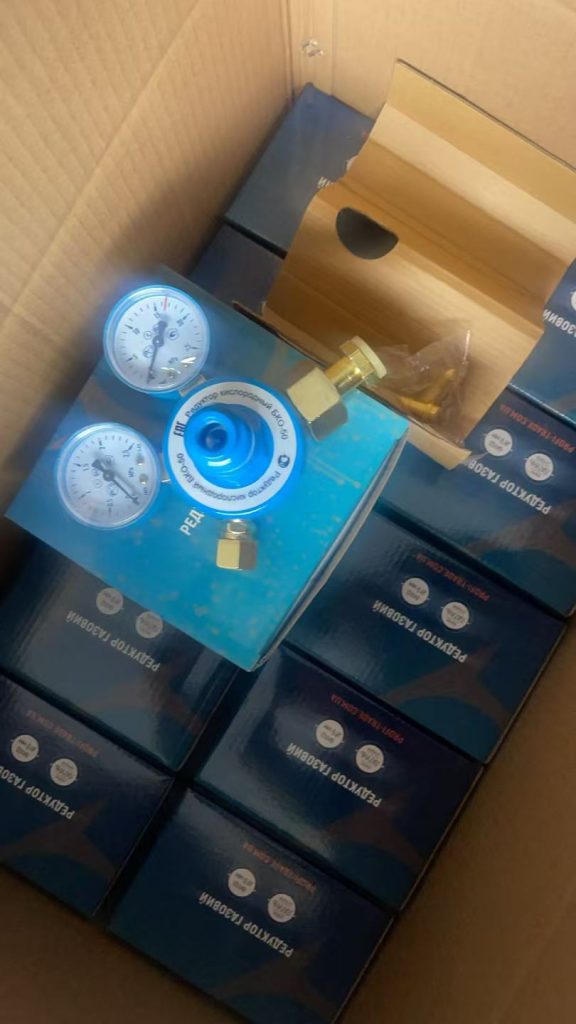
This article provides a practical step-by-step guide to help avoid common failures of Russian gas regulators in welding operations. The content covers three core points of selection, operation, and maintenance, suitable for operator training, product appendices, and customer technical support. Following these specifications can significantly reduce failure rates, ensure welding safety and quality, and extend the service life of regulators
I. Avoid Problems from the Source: Correct Regulator Selection (Most Critical)
Choosing a high-quality, Russian-standard regulator that matches the welding scenario is the fundamental way to avoid faults. Focus on the following key indicators:
1. Use Forged Brass Valve Body, Reject Zinc Alloy/Inferior Die-Cast Copper
– Common Problem: Easy cracking, internal leakage, corrosion, and short service life due to poor material.
– Solution: AdoptHPb59-1 forged brass for the valve body. It features high strength, resistance to high and low temperatures, and no easy internal leakage, ensuring 3–5 years of stable use in industrial environments.
2. Sealing Components Must Be Low-Temperature Resistant Fluororubber (FKM)
– Common Problem: Ordinary rubber hardens, becomes brittle, and leaks in extremely low temperatures (-30℃~-40℃) in Russia, Kazakhstan, and Siberia.
– Solution: Use FKM seals with a working temperature range of -40℃~120℃, which will not crack, harden, or leak even in frigid environments.
3. Pressure Stabilization Structure: Double Spring/Double-Stage Stabilization
– Common Problem: Fluctuating output pressure leads to welding porosity, sparking, and arc breakage, reducing welding quality.
– Solution: Ensure the output pressure fluctuation is ≤ ±2%, maintaining stable gas flow throughout the welding process to avoid unstable arcs.
4. Russian-Standard Threads: High-Precision Processing (W21.8-14 / G5/8)
– Common Problem: Failure to fit Russian gas cylinders, thread slipping, and leakage due to low-precision threads.
– Solution: Process threads strictly in accordance with GOST 13861-91. The regulator can be directly screwed onto Russian gas cylinders without wrapping a large amount of PTFE tape.
5. Reliable and Sensitive Safety Valve
– Common Problem: Safety valve failure (no pressure relief when overpressurized) leads to potential safety accidents such as cylinder explosions.
– Solution: Conduct 100% airtightness and pressure resistance tests before delivery. The safety valve will automatically relieve pressure when the pressure exceeds the standard, protecting the cylinder and operators.
6. Shockproof, Shatterproof, and High-Precision Pressure Gauge
– Common Problem: Gauge damage and inaccurate readings due to vibration in workshops or construction sites.
– Solution: Use shockproof oil-immersed pressure gauges with an accuracy class of C2.5 or higher to ensure stable and accurate readings in harsh environments.
II. Avoid Problems from Operation: Correct Usage Guidelines (For Welders)
90% of regulator faults are caused by incorrect operation. Train welders to follow these steps strictly:
1. Startup Procedure: Open the Cylinder Valve First → Then Adjust the Pressure
– Wrong Operation: Adjust the pressure first before opening the cylinder valve, causing instant high-pressure impact on the diaphragm.
– Consequence: Direct damage to the regulator and internal leakage.
2. Shutdown Procedure: Loosen the Pressure Adjustment Handwheel First → Then Close the Cylinder
– Wrong Operation: Close the cylinder directly without releasing the pressure.
– Consequence: Pressure is trapped inside the regulator, damaging components when restarted next time.
3. Do Not Mix Different Types of Gases
– Oxygen regulators: For oxygen only.
– Propane/acetylene regulators: For flammable gases only.
– Argon/CO₂ regulators: For protective gases only.
– Consequence: Mixing gases may cause explosions, combustion, or corrosion of the regulator.
4. Do Not Drop, Hit, or Use Upside Down
– Gas regulators are precision valves, not heavy-duty metal parts.
– Consequence: A single drop can damage the pressure gauge, misalign the valve core, and cause internal leakage.
5. Regular Pre-Use Inspection
Check the following items daily before use to extend the regulator’s service life by 2x:
- Check for gas leakage (use soapy water to detect bubbles).
- Inspect threads for damage or wear.
- Check seals for aging or cracking.
- Verify that the pressure gauge reads accurately.
III. Avoid Problems from Maintenance: Regular Maintenance Guidelines (For Factories)
Neglecting maintenance is the main reason for short regulator service life. Implement these simple maintenance steps:
1. Replace Seal Kits Every 6–12 Months
– This is the most cost-effective maintenance measure.
– A set of seals costs only a few dollars, but it can prevent the entire regulator from being scrapped.
2. Keep Interfaces Clean (No Dust, No Oil Stains)
– Oil stains mixed with oxygen can cause immediate combustion or explosion.
– This is a critical safety requirement on Russian construction sites and factories.
3. Cover with Dust Caps When Not in Use
– Dust, welding slag, and debris in the workshop can enter the valve body, causing jamming and leakage.
– Always use the dust cap to protect the regulator when it is not connected to the cylinder.
IV. Safety and Stability Commitment (For Customer Communication)
Our Russian-style gas regulators completely eliminate common problems during welding operations:
- No leakage even at -40℃ (adaptable to frigid environments).
- Stable pressure with no fluctuation, avoiding welding defects.
- GOST-standard threads, fitting Russian gas cylinders perfectly without modification.
- Forged brass valve body with a service life of 3–5 years.
- Reliable safety valves and shockproof pressure gauges.
- Full compliance with GOST 13861-91 and EAC certification.
You will get a regulator that never lets you down on the welding site, ensuring safe, efficient, and high-quality welding operations.
Our Derkia Group is a professional manufacturer of Russian pressure reducers, targeting markets such as the Commonwealth of Independent States, Kazakhstan, Uzbekistan, Turkmenistan, Kyrgyzstan, etc. Welcome to order and contact us :sales@derkia.com