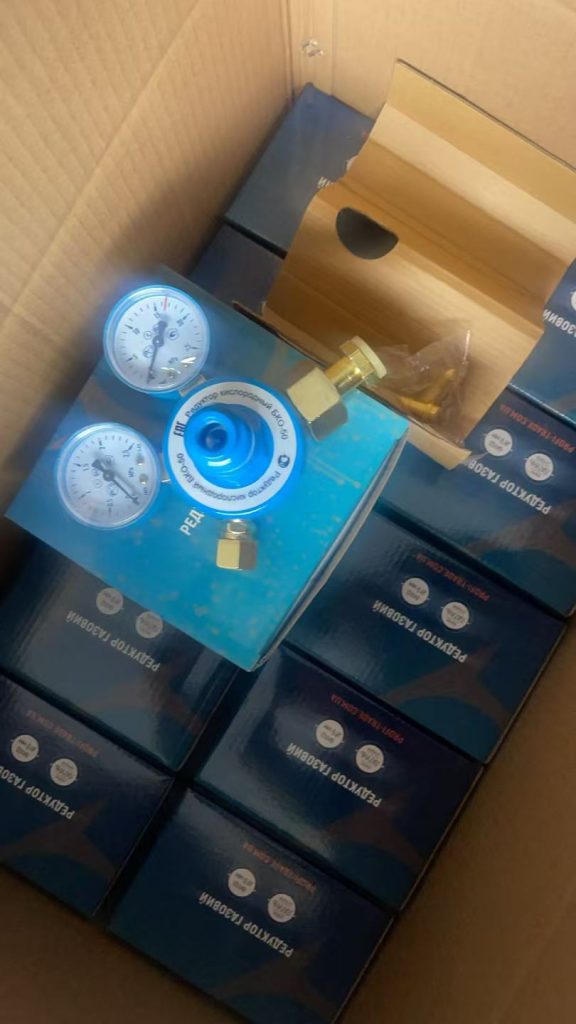
In welding work, propane pressure reducers are prone to problems such as unstable pressure, flashback risk, leakage, and jamming. When selecting, it is important to focus on core elements such as flow matching, safety, environmental adaptability, material and certification. The following is a detailed analysis:
For example, ultra-low temperature freezing and brittle cracking caused by climate and environment, and freezing at the inlet of the pressure reducer in winter (-30 ℃~-40 ℃), resulting in interrupted airflow; The plastic casing or sealing ring is brittle and leaking air. Propane vaporizes and absorbs heat, causing a sudden drop in temperature at the valve port of the steel cylinder. Moisture in the air condenses into ice, blocking the filter screen; Ordinary rubber seals (such as nitrile NBR) harden and lose their elasticity at -40 ℃, while brass valve bodies become brittle. Outdoor operations, and some steel cylinders without insulation measures, result in several times more severe icing problems than in temperate regions. Wind and sand invasion and wear, adjust the hand wheel for jamming and pressure.
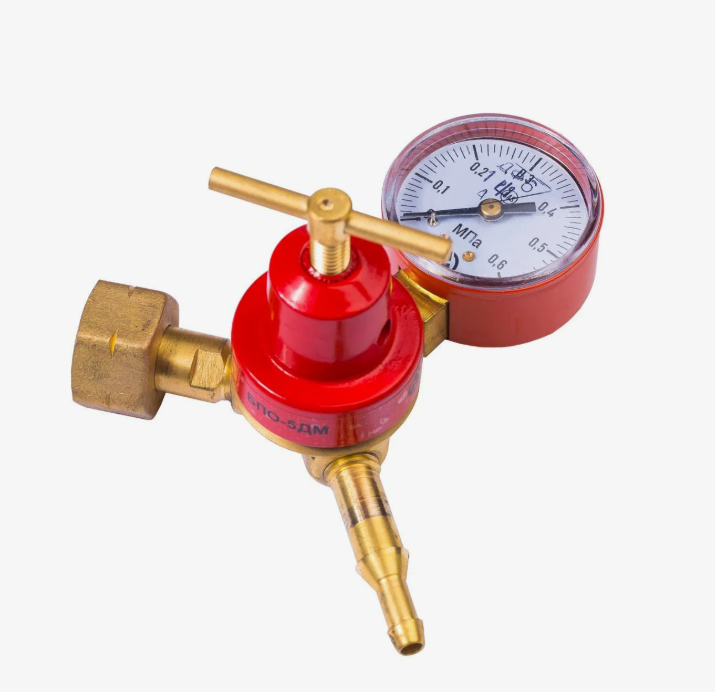
Pressure pulsation (“surge”) and fluctuating flames can also commonly occur during welding, affecting the quality of the weld due to insufficient membrane stiffness or clogged filter screens. Tempering explosion caused the flame to reignite to the pressure regulator due to the lack of a tempering preventer or aging of the hose. Interface leakage, thread leakage, ignition in case of sparks, loosening due to poor propane resistance or vibration of the sealing gasket. Adjustment is stuck, the handwheel cannot be turned, due to sand and dust intrusion or lubrication failure. Insufficient flow rate, weak flame during high current welding, due to the selection of too small flow rate.
So when choosing a pressure reducer, the focus is on:
1. Flow and pressure matching (core parameters. The rated flow must be ≥ the maximum gas consumption of the welding torch (refer to the welding torch manual, such as 0.5-1 m ³/h for small welding guns and 2-4 m ³/h for large cutting torches).
Note: Insufficient flow can cause a sudden drop in pressure and weak flames.
Export pressure range: It needs to cover the working pressure of the welding torch (usually 0.01-0.3 MPa).
Inlet pressure: Confirm the appropriate cylinder pressure (propane cylinders are usually ≤ 2.5 MPa, and the image indicates 25 bar, which is 2.5 MPa and meets the requirements).
2. Safety protection design: Must be equipped with a tempering preventer: It is strictly prohibited to use a pressure reducer alone in welding scenes, and a built-in tempering valve or an external preventer should be selected.
Overpressure protection: Confirm the presence of a safety relief valve (which automatically exhausts when overpressure occurs, with the image labeled “maximum working pressure 0.3 MPa” indicating the safety limit).
Leak proof structure: Metal sealing gaskets (copper/aluminum gaskets) are preferred to avoid the presence of raw materials (not resistant to propane solvents).
3. Environmental and working condition adaptability: One is temperature resistance performance:
In high temperature scenarios (such as summer+40 ℃): the sealing ring needs to be heat-resistant (FKM fluororubber can withstand 200 ℃);
In low-temperature scenarios (such as Central Asia winter -40 ℃): the shell is anti brittle and the sealing ring is cold resistant (fluororubber is resistant to -40 ℃).
Another is dust and sand prevention:
Outdoor/construction site use: choose dust-proof handwheel or add dust-proof cap;
Add a protective cover to the pressure gauge to prevent damage from welding spatter.
4. Material and reliability:
Main material: preferably brass (corrosion-resistant, good thermal conductivity), avoiding cast iron (easy to rust) or ordinary plastic (easy to age).
Selection of key components:
Diaphragm: Nylon reinforced rubber (anti fatigue, pressure resistant);
Spring: Stainless steel (rust proof, pressure stable).
5. Certification and Compliance
Compulsory certification: Gas appliances must be certified (such as China CQC, EU CE, Russian GOST) to ensure safety standards.
Third party testing: Priority should be given to products with SGS/T Ü V reports to prove their pressure resistance and airtightness are qualified.
6. Convenience of operation and maintenance:
Adjustment method: The handwheel should have moderate torque (too tight is difficult to adjust, too loose is prone to drift), and it is better to have a scale indicator.
Filter design: Removable and washable filter (mesh size ≥ 100) for easy handling of impurities.
Universality of spare parts: Whether vulnerable parts such as sealing rings and pressure gauges are of standard specifications for easy local procurement.
| Selection Comparison Table for Welding Scenarios | ||
| Parameters/Characteristics | Recommended choice (for welding) | Avoid making choices (high risk) |
| Traffic volume | Maximum gas consumption of welding torch × 1.2 times (margin) | Less than the welding torch requirement |
| Security protection | Maximum gas consumption of welding torch × 1.2 times (margin) | No safety valve or external preventer required |
| Sealing material | Equipped with flashback preventer and safety relief valve | Nitrile rubber (NBR, not resistant to high/low temperatures) |
| Interface | Equipped with flashback preventer and safety relief valve | Only rely on sealing with raw material tape |
| Pressure gauge | Shock resistant meter, measuring range 0-0.6 MPa, with protective cover | Ordinary gauge, unprotected |
| Certification | CE+CQC or GOST (required in Central Asia) | No certification or only self inspection by the enterprise |
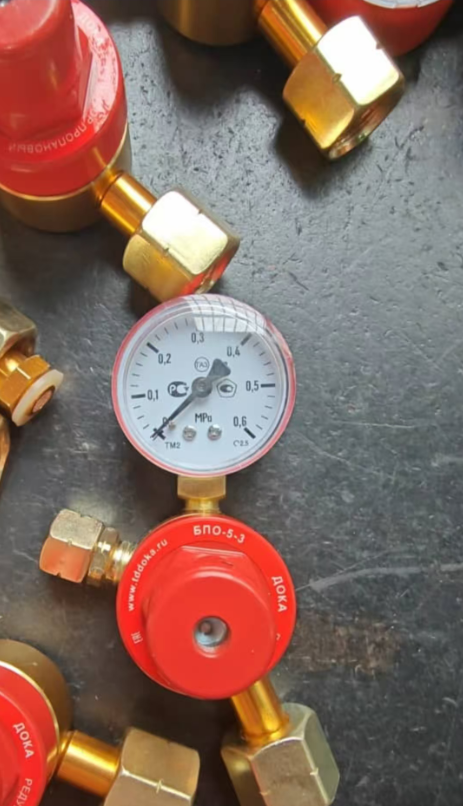
Our DERKIA company is the largest Russian pressure regulator production source factory in China,
We specialize in producing pressure reducers for the national markets of Russia, Kazakhstan, Kyrgyzstan, Tajikistan, Turkmenistan, and Uzbekistan,etc.
We sincerely invite you to contact us. Please provide your specific application scenario (such as welding type, gas usage, pressure and flow requirements), and our engineers will recommend the most suitable model for you and arrange sample testing.