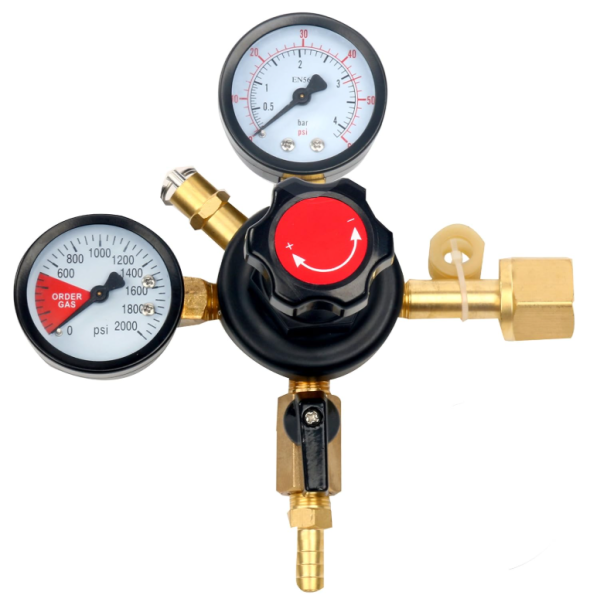
Dual CO2 BEER dispersing regulator – High pressure dual specification mixed gas CO2 regulator cga320
1. Pressure gauge parameters
High voltage gauge:
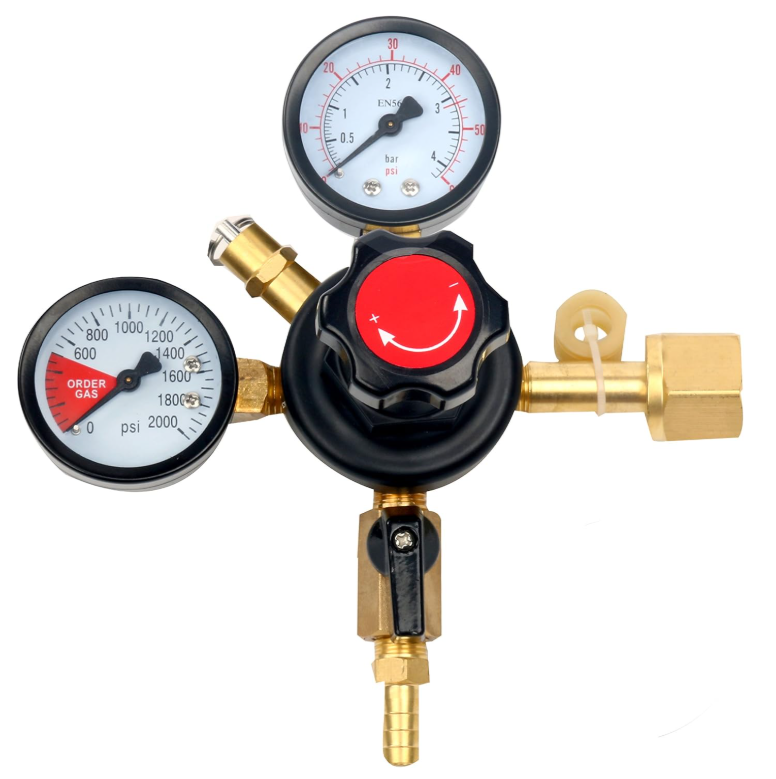
Range: 0~25 MPa (megapascals), or corresponding to 0~3600 psi (pounds per square inch).
Function: Measure the residual gas pressure inside the gas cylinder.
Low voltage gauge:
Range: 0~0.6 MPa (megapascals), or corresponding to 0~100 psi (pounds per square inch).
Function: Measure the output working pressure after decompression.
Scale marking: The dial is marked with a red area labeled “ORDER GAS” (inflation/ordering gas), located at around 200 psi, indicating that the gas in the cylinder is insufficient and needs to be replenished.
2. Connection interface parameters
Air intake (right brass interface):
Thread specifications: G5/8 “(imperial thread) or W21.8 (European standard cylinder thread, commonly used for 8L, 15L, 40L carbon dioxide cylinders, etc.).
Connection object: Carbon dioxide steel cylinder valve.
Air outlet (bottom brass joint):
Joint type: Usually a quick plug pagoda joint with a diameter of 6mm or 8mm (shown as a slender pipe joint in the picture).
Connection object: Gas pipeline.
3.Performance parameters (refer to similar standards)
Maximum input pressure: 25 MPa (250 bar).
Rated output pressure: 0~0.6 MPa (adjustable).
Accuracy level: 2.5.
Working environment temperature: -20 ℃~+60 ℃.
Applicable medium: Carbon dioxide (CO ₂).
FAQ:
Q: What should I pay attention to before installing a newly purchased or just opened pressure reducer onto a gas cylinder?
Answer: Before turning on the pressure reducer, gently open the valve of the gas cylinder to blow away the dust and impurities at the valve outlet, to prevent these foreign objects from entering the inside of the pressure reducer, causing damage to the seals or adjustment failure.
Q: How to install it correctly on a carbon dioxide cylinder?
Answer: Align the inlet of the pressure reducer with the outlet of the steel cylinder valve and tighten it clockwise with a wrench (usually with a right-hand thread). Pay attention to fixing the steel cylinder to prevent it from tipping over during installation.
Q: Why can’t I place my hand directly in front of the exhaust port when opening the gas cylinder valve?
Answer: When opening the gas cylinder valve, the speed should be slow and the body should not face the outlet directly. Because if high-pressure gas suddenly sprays out, it will generate a huge impact force, which may spray impurities or ice debris at high speed and injure people, which is very dangerous.
Q: Why does the outlet of the pressure regulator freeze or even frost during use?
Answer: This is a physical phenomenon caused by the absorption of a large amount of heat by carbon dioxide gas during the decompression process. If it is a regular pressure reducer, this is a normal situation; If it is an electric heating model, it may be due to not connecting the power supply or temperature control failure.
Q: What should be done if the pressure regulator freezes?
Answer: Thawing can be done with warm water or steam, but it should never be done with open flames or high-temperature iron blocks, as it can easily cause damage to the rubber parts of the pressure regulator or fire accidents.
Q: How to adjust the output pressure?
Answer: After opening the gas cylinder valve, turn the red pressure regulating knob (adjusting handwheel) clockwise to increase the output pressure; Rotate counterclockwise to reduce pressure. When adjusting, operate slowly and observe the low pressure gauge pointer until it reaches the desired value.
Q: What do the two pressure gauges on the pressure reducer represent respectively?
Answer: The larger gauge above is a high-pressure gauge that displays the pressure of the remaining gas in the cylinder; The smaller gauge below is a low-pressure gauge that displays the pressure output to the equipment after pressure reduction.
Q: Can pressure reducers for different gases be interchangeable?
Answer: It’s not possible. Carbon dioxide pressure reducers can only be used for carbon dioxide gas and are strictly prohibited from being mixed with oxygen, acetylene, and other pressure reducers to avoid the risk of explosion or poisoning due to different gas characteristics.
Q: How should I properly close it after use?
Answer: First, tighten the pressure regulating knob clockwise (to zero the output pressure), then close the main valve of the gas cylinder, and finally open the valve at the equipment end to exhaust the gas in the pipeline to protect the pressure reducer spring.
Q: Do pressure reducers need regular calibration?
Answer: Yes. Pressure gauges usually require mandatory calibration once a year to ensure accurate readings; The pressure reducer body also needs to be regularly inspected for sealing and component wear to ensure safe use.