Oxygen Regulator with Dual Gauge – Industrial Grade for Welding, Medical & Lab Use – High Pressure Control Valve
Specification:
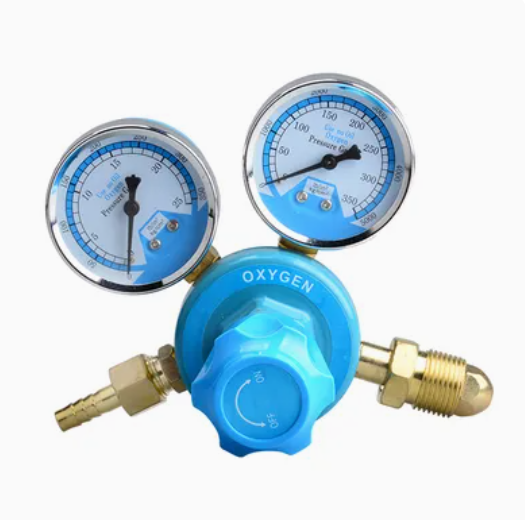
1. Applicable gas: Oxygen (O ₂) – clearly labeled as “OXYGEN”, do not mix other gases (such as acetylene, argon, etc.) to prevent combustion or explosion risks.
2. Input pressure range (high-pressure gauge): 0~25 MPa (or 0~250 bar/3600 psi) – used to display the remaining pressure inside the gas cylinder.
3. Output pressure range (low pressure gauge): 0~2.5 MPa (or 0~25 bar/360 psi) – used to regulate and indicate the output working pressure.
4. Adjustment method: Manually rotate the blue hexagonal adjustment handwheel to increase pressure clockwise and decrease pressure counterclockwise (specific direction is subject to the physical identification).
5. Interface thread specifications:
Air inlet: G5/8 “right-hand thread (standard oxygen cylinder interface, some models are M16 × 1.5)
Air outlet: Φ 8mm or Φ 10mm pagoda hose connector (compatible with common oxygen pipes)
6. Material composition:
Main body shell: aluminum alloy or zinc alloy (blue spray paint)
Joint and valve core: brass (corrosion-resistant, explosion-proof)
Pressure gauge dial: glass+metal shell, pointer type mechanical gauge
7. Accuracy level of pressure gauge: usually 2.5 level (error ± 2.5%), meeting the requirements of industrial and general welding use.
FAQ:
Q: Can this pressure regulator be used for acetylene or argon?
Answer: It’s not possible. This product is designed specifically for oxygen (OXYGEN) and must not be mixed. The internal structure of different gas pressure reducers is different, and mixing them can easily cause combustion or explosion accidents.
Q: Why is it strictly prohibited to come into contact with grease during use?
Answer: Oxygen in contact with oil under high pressure can generate heat through intense friction, which may lead to spontaneous combustion or explosion. Therefore, the surface, threads, and interfaces of the pressure reducer must be kept clean and strictly prohibited from being contaminated with any grease or oil.
Q: What are the correct operating steps?
Answer: ① Before installation, slightly open the gas cylinder valve to blow away impurities; ② First loosen the adjustment knob (to reset the low pressure gauge to zero), then slowly open the gas cylinder valve; ③ After observing no leaks, slowly rotate the adjustment knob to the desired pressure.
Q: How to determine if the pressure regulator is leaking?
Answer: After installation, apply soapy water or use a specialized leak detector to test the interface. Do not use open flames for detection! If there are continuous bubbles emerging, it indicates a gas leak, and the cylinder valve should be immediately closed and tightened or the seal replaced.
Q: Why does the pressure regulator freeze or frost? How to handle it?
Answer: High pressure gas throttling expansion causes heat absorption. The use of open flames for baking should be prohibited. It should be slowly thawed with warm water or steam, otherwise it may cause a fire or equipment damage.
Q: What do I need to do after stopping use?
Answer: The main valve of the gas cylinder should be closed first. After the high pressure gauge pointer returns to zero, the adjustment knob (pressure relief) should be loosened to reset the low pressure gauge pointer to zero. Finally, the remaining gas should be released to prevent the spring from being deformed under long-term pressure.
Q: What are the functions of dual watches (two dials)?
Answer: The large dial (on the right) displays the high pressure inside the gas cylinder (input pressure); The small dial (on the left) displays the adjusted working pressure (output pressure).
Q: What should I do if the low pressure gauge pointer shakes or rises too quickly when adjusting the pressure?
Answer: It may be due to carbon accumulation in the valve core inside the pressure reducer, impurities sticking, or aging of the diaphragm. It should be immediately stopped from use and sent to a professional organization for repair or replacement. Do not disassemble it without authorization.
Q: Do pressure reducers need regular calibration?
Answer: Yes. To ensure accurate readings, pressure gauges need to be regularly inspected (usually once a year) to ensure measurement accuracy meets safety standards.
Q: Can oxygen pressure reducers and acetylene pressure reducers be interchanged?
Answer: It’s not possible. The structural design of the valve body for oxygen pressure reducers is different from that of acetylene pressure reducers (which have flame arresters inside), and mixing them poses serious safety hazards. Therefore, it is necessary to use specialized equipment for this purpose.